

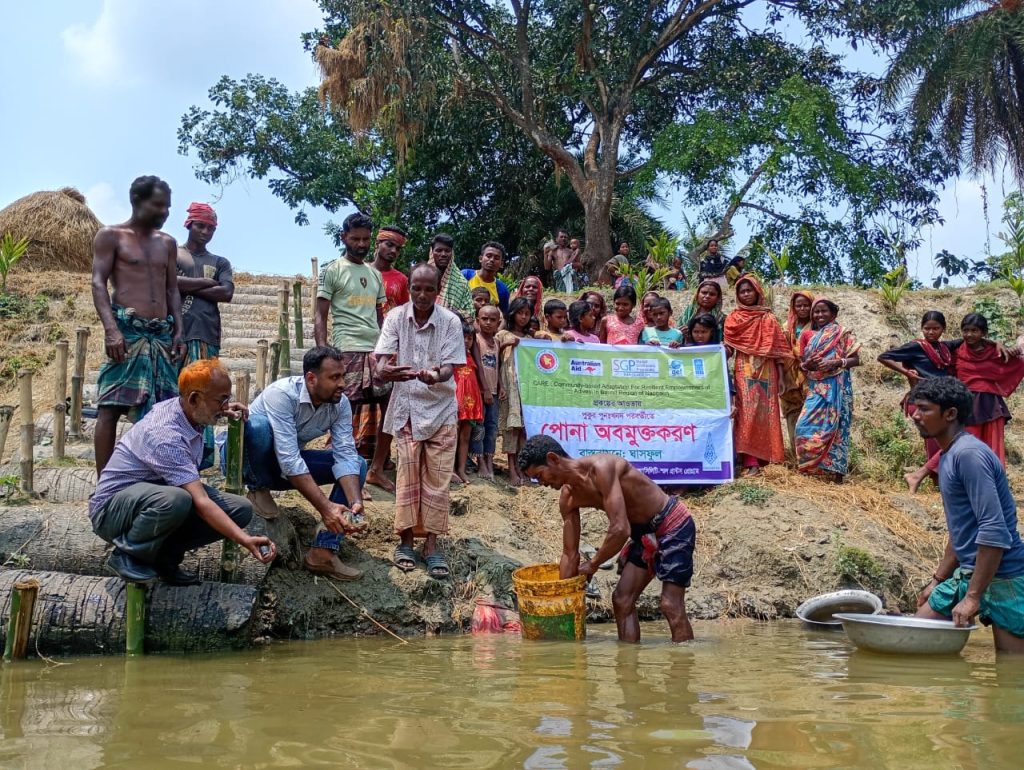
As fish fingerlings were released into the ponds of Chakboni and Satgachhi villages in Badalgachhi Upazila, it was not just fish entering the water—it was a symbol of renewed hope, food security, and economic resilience for the indigenous communities.
On 2 June 2026, under the Ghashful CARE Project, a total of 1,294 fish fingerlings weighing 167 kg were released into re-excavated ponds. The species included 225 Silver Carp, 119 Catla, 240 Rui, 250 Mrigal, and 160 Mirror Carp, among others.
Many indigenous communities in Bangladesh continue to face challenges due to limited access to natural resources, climate change impacts, and economic uncertainty. In this context, water-based livelihood initiatives offer a sustainable pathway toward resilience. With this vision, Ghashful is implementing the Community-based Adaptation for Resilient Empowerment of Adivasi in Barind region (CARE) Project with support from the United Nations Development Programme–GEF Small Grants Programme and Australian Aid.
Pond re-excavation and fish farming are not merely agricultural interventions—they are long-term strategies for improving food security, nutrition, and income generation. The harvested fish will contribute to household nutrition while also creating opportunities for additional income through market sales.
The fish stocking event was attended by Assistant Director Md. Saiyeedur Rahman Khan and Technical Manager Md. Amir Hamza, along with other project officials. They engaged with community members and provided guidance on pond management and fish farming practices.
Project officials emphasized that such initiatives will continue to support sustainable use of natural resources, improve livelihoods, and build climate-resilient communities among indigenous populations.
Once waterlogged and underutilized, these ponds are now becoming sources of life and opportunity. In Chakboni and Satgachhi, it is not only fish that will grow—but also confidence, self-reliance, and the promise of a better future.
Last Updated on: June 4, 2026