

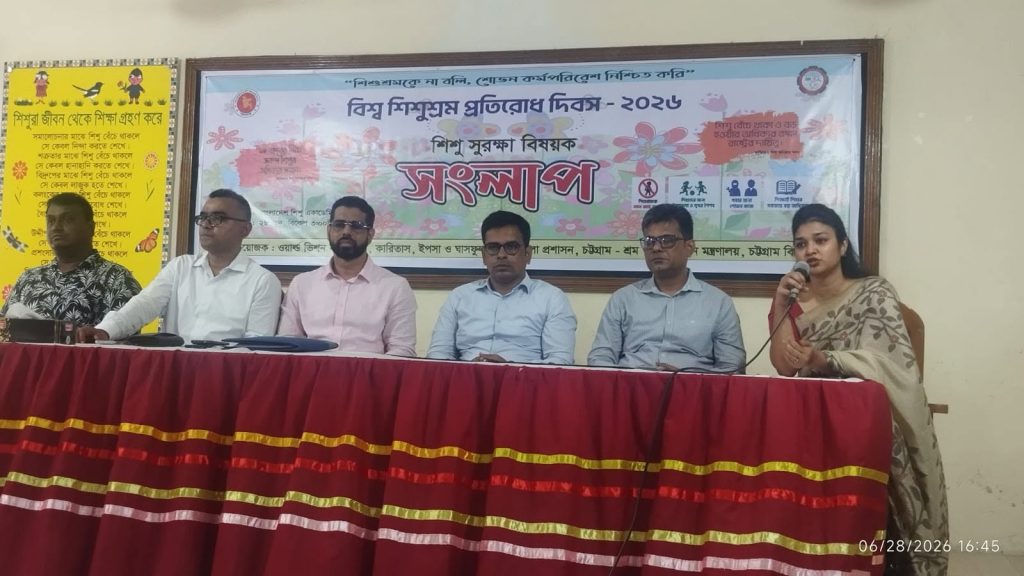
With the message “Say no to child labour, ensure decent working conditions,” a special child protection dialogue, cultural program, and prize-giving ceremony was held in Chattogram on 28 June to mark World Day Against Child Labour 2026.
Jointly organized by World Vision Bangladesh, Ghashful, Caritas, and YPSA, the event went beyond formality and became a meaningful platform for reflection, dialogue, and collective commitment among policymakers and development practitioners.
The program began at the Bangladesh Shishu Academy in Chattogram, where children expressed their hopes for a discrimination-free and protected childhood through drawings and creative activities. Their artwork stood in sharp contrast to the reality faced by many children in the city, who continue to work in hazardous and exploitative conditions.
The main dialogue started at 3:00 PM and highlighted the global and regional urgency of the issue. Referring to recent International Labour Organization data, speakers noted that around 138 million children worldwide are still engaged in child labour, including 54 million in hazardous work.
Deputy Inspector General of the Department of Inspection for Factories and Establishments, Chattogram, Mahbubul Alam, attended as the key discussant and emphasized that legal enforcement alone is not enough without stronger social awareness and collective action.
Speaking as a panelist, Ghashful Deputy Director Sadia Rahman said that poverty, limited access to quality education, and deep social inequality continue to push children out of school and into labour. She stressed that without breaking this cycle, sustainable development cannot be achieved.
Other panelists included Marcel Ratan Guda, Regional Director of Caritas Bangladesh; Johny Rozario, Area Manager of World Vision Bangladesh; Mohammad Ali Shahin, Head of Advocacy at YPSA; Enamul Hasan, District Coordinator of BRAC; Bishwajit Sharma, Inspector of the Department of Inspection for Factories and Establishments; and Zaynab Begum Mitu from Sangsaptak.
The session was moderated by Sirajul Islam, Project Coordinator of Ghashful, and Payel Christina Das of World Vision Bangladesh. Speakers agreed that child labour cannot be eliminated through policy alone. Stronger social protection for vulnerable families, quality education for every child, and coordinated action by government, civil society, and development partners are essential to building a child labour-free future.
The event concluded on a hopeful note with cultural performances by students from Ghashful Bikash Kendra at Sebok Colony and an engaging quiz session by students of Paran Rahman School, where children voiced their rights, dreams, and aspirations.
Prizes were also awarded to the winners of the drawing competition. More meaningful than the trophies or medals, however, were the smiles on the children’s faces—a reminder that with the right opportunities, they can help build a safer, brighter, and child labour-free Chattogram.