

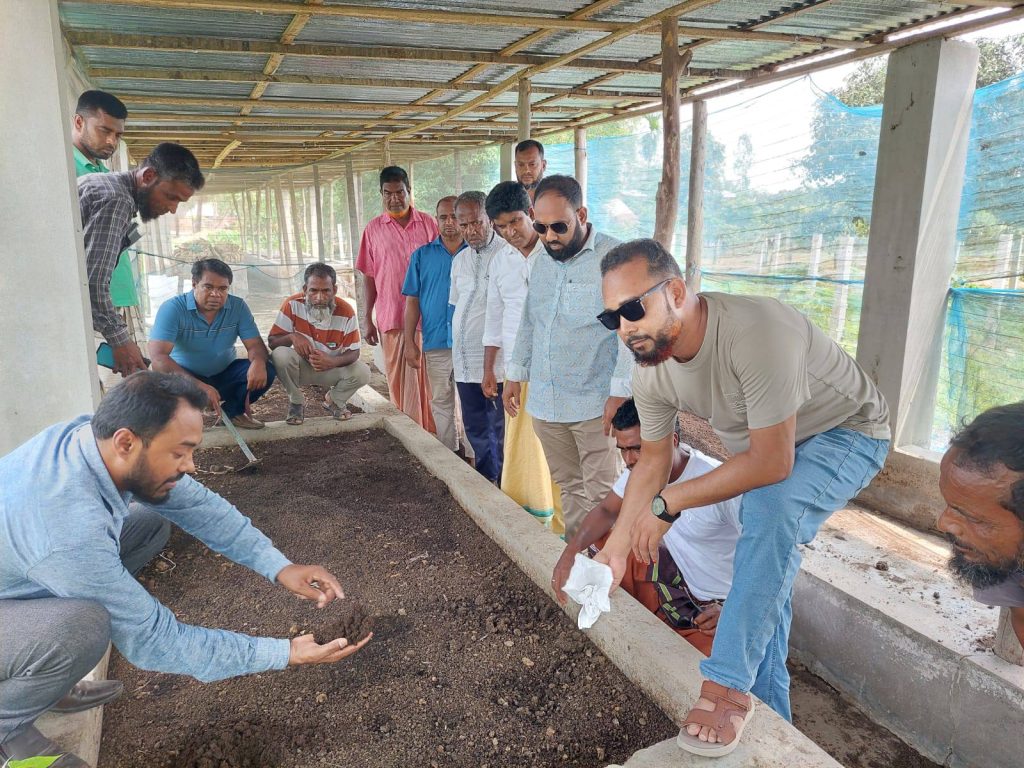
Under the SMART Project funded by the World Bank and Palli Karma-Sahayak Foundation (PKSF), Ghashful is working across five upazilas of Naogaon—Sapahar, Porsha, Niamatpur, Patnitala, and Dhamoirhat—supporting nearly 1,000 fruit growers to adopt safe, profitable, and environmentally sustainable farming practices.
As part of this initiative, a day-long training on “Environment-friendly Fruit Cultivation and Good Agricultural Practices (GAP)” was held on 23 April at the Niamatpur Branch Office. The training focused on safe food production, sustainable agriculture, and strategies to enhance market competitiveness.
A key highlight of the session was hands-on learning, where farmers gained practical knowledge on soil testing and sampling, organic fertilizer production (compost and vermicompost), and modern techniques such as pruning, de-suckering, and mulching. Crop-specific GAP guidelines were also shared, including pheromone trap use in mango, drip irrigation in strawberry, citrus disease management, fruit bagging in jujube and guava, and trellis and manual pollination techniques in dragon fruit.
The training also emphasized value addition and market access, covering post-harvest management, local markets, online platforms, and branding through Farmer Producer Organizations (FPOs) to ensure fair pricing.
The sessions were facilitated by Assistant Director K.M.G. Rabbani Bosunia, Scientific Officer Abu Saleh Md. Yusuf Ali, Upazila Agriculture Officer Md. Rafiqul Islam, and Technical Officers Kamrul Hasan and Mosabbir Ahmed.
The core message of the training was clear: modern agriculture is no longer just about production—it is an integrated system of knowledge, technology, branding, and trust. With the right practices and timing, farmers can access premium markets while ensuring safe food, better incomes, and environmental sustainability.
Ghashful believes that safe and chemical-free agriculture is not just a technique—it is a long-term commitment to public health, farmer prosperity, and a sustainable future.