

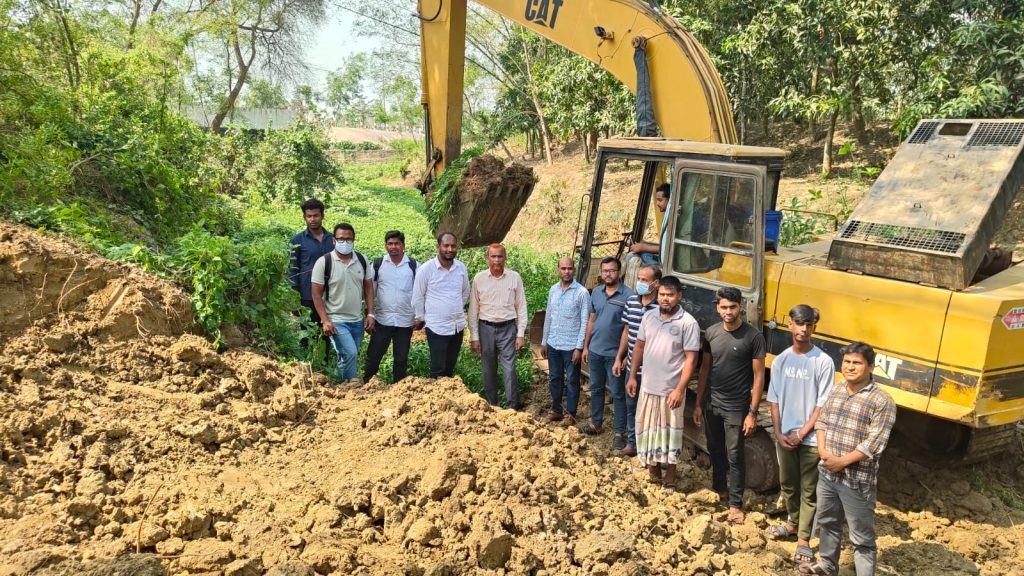
The formal inauguration of a 6-kilometer canal re-excavation initiative took place on 1 April in Niamatpur Upazila. The activity is being implemented by Ghashful under the Extended Community Climate Change Project–Drought (ECCCP-Drought), titled “Canal Package 001 — 6 KM,” with support from Palli Karma-Sahayak Foundation (PKSF) and the Green Climate Fund.
As part of its broader commitment, Ghashful has planned to re-excavate a total of 18 kilometers of canals during the current fiscal year, with this 6-kilometer stretch marking the first phase of implementation.
The inauguration ceremony was attended by Assistant Director and Project Focal K.M.G. Rabbani Bosunia, Project Coordinator Engineer Mohammad Abdullah, Zonal Manager Md. Anwar Hossain, along with community representatives, contractor representatives, and other project officials.
Participants expressed optimism that the canal re-excavation will enhance local agricultural productivity, improve water availability, and reduce water scarcity in the Barind region. Such initiatives are expected to strengthen local water conservation and environmental resilience, while significantly contributing to the recovery of drought-affected agriculture and livelihoods.
The Project Coordinator and Focal emphasized the importance of timely and quality implementation through continued collaboration and partnership. Contractor representatives and local stakeholders were also urged to ensure adherence to timelines and quality standards.
The ECCCP-Drought Project is being implemented to improve drought-resilient water management in the Barind region, increase both surface and groundwater storage, and promote climate-resilient agricultural technologies and infrastructure. The project is currently active across approximately 14 drought-prone upazilas and is expected to directly benefit around 215,000 people, with wider indirect impacts across surrounding areas.
Key interventions include canal and pond re-excavation, groundwater recharge through Managed Aquifer Recharge (MAR) systems, promotion of drought-tolerant crop technologies, and community capacity building and training. These efforts are contributing to increased agricultural production, improved water levels, and the adoption of low water-demand farming practices.
Local farmers and community members have expressed hope that the initiative will help address long-standing water scarcity and agricultural challenges in the Barind region, ensuring adequate irrigation for Boro and other crops, and bringing positive changes to livelihoods and local economic activities.