

In the drought-prone Barind region of Naogaon, drought is not just a seasonal challenge—it is a daily reality for many small ethnic minority families living with water scarcity, uncertain agriculture, and limited income opportunities.
In response to this reality, Ghashful launched the CARE: Community Based Adaptation for Resilient Empowerment of Adivasi in Barind Region of Naogaon project 18 months ago with support from UNDP. Although the project has now formally concluded, local communities in Badalgachhi believe it has not marked an ending, but rather the beginning of a new chapter of climate-resilient living.
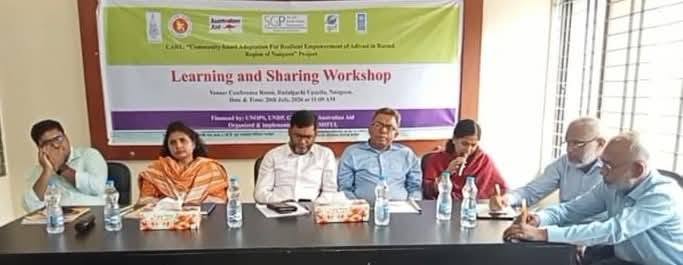
A closing Learning and Sharing event was held on Monday, 20 July, at the Badalgachhi Upazila Auditorium, bringing together local administration officials, representatives from government departments, UNDP, development practitioners, and beneficiary indigenous women and men. The event highlighted the changes that have taken place in local livelihoods over the past year and a half.
The program was chaired by Upazila Nirbahi Officer Israt Jahan Chhony. The Chief Guest was Md. Rezaul Karim, Additional Deputy Director (Horticulture), Department of Agricultural Extension, Naogaon. Special guests included UNDP National Coordinator Dr. Muhammad Mozammel Haque, Upazila Livestock Officer Dr. Ripa Rani, and Agriculture Officer Sabab Farhan. The event was moderated by Ghashful Assistant Director (SDP) K.M.G. Rabbani Basunia. Assistant Director (Microfinance) Sayeedur Rahman and other project officials, local representatives, government officials, and beneficiaries were also present.
Speakers noted that the project has created visible positive change in Badalgachhi, particularly in improving the livelihoods of small ethnic minority households. They appreciated the sincerity, efficiency, and community-centered approach demonstrated by Ghashful in implementation, and expressed hope that similar initiatives could be expanded to other climate-vulnerable unions.
One of the project’s most visible interventions was the re-excavation of an old pond in Chakbeni Adivasi Para of Mathurapur Union. In a region facing severe water stress, the restored pond is now creating new opportunities for rainwater retention, fish cultivation, livestock watering, and agricultural use. Beyond pond restoration, the CARE Project also introduced a more integrated adaptation model through drought-resilient agriculture, improved livestock rearing, homestead vegetable cultivation, vermicompost production, safe poultry and fish farming, Managed Aquifer Recharge (MAR) technology, fuel-efficient stoves, and climate adaptation training.
The project also played an important role in women’s empowerment. Local women became actively engaged in adaptation planning, household decision-making, and income-generating activities, including vegetable cultivation, organic fertilizer production, and poultry rearing. Over its 18-month duration, the project directly benefited around 400 indigenous families in Badalgachhi Sadar and Mathurapur unions.
Implemented from February 2025 with support from UNDP and the GEF Small Grants Programme (GEF-SGP), the initiative is now being regarded as an effective community-based adaptation model for the Barind region—promoting safe water management, climate-resilient agriculture, and sustainable livelihoods.
As participants reflected at the closing event, the project may have formally ended, but its greatest success lies in the seed of adaptation it has planted in people’s minds. In the drought-affected landscape of Barind, that seed may well grow into a greener, stronger, and more resilient future.