

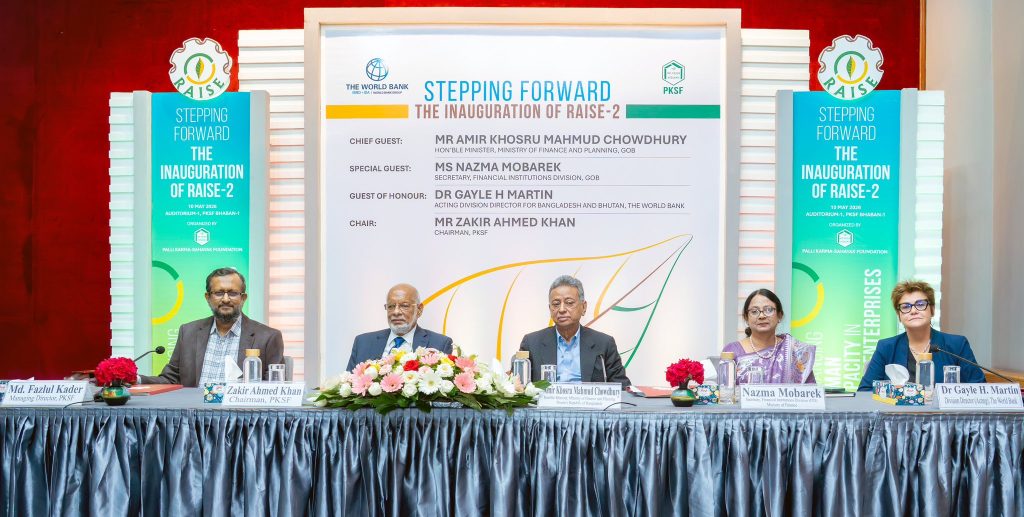
The Finance and Planning Minister Amir Khasru Mahmud Chowdhury emphasized that democratizing the economy lies at the heart of the current government’s political vision, aiming to ensure participation of all citizens in economic activities. He reaffirmed the government’s full support to Palli Karma-Sahayak Foundation (PKSF) in implementing such initiatives.
He made these remarks as the Chief Guest at the inauguration of the second phase of the RAISE Project, titled “Stepping Forward: The Inauguration of RAISE-2,” held at PKSF Bhaban-1 in Agargaon, Dhaka.
The event was chaired by PKSF Chairman Zakir Ahmed Khan. Special Guest Nazma Mobarak highlighted PKSF’s role not only in financing but also in enhancing skills, providing technical support, and strengthening market linkages for sustainable development of marginalized communities.
Distinguished Guest Dr. Gayle H. Martin from the World Bank stressed the need to equip over two million youth entering Bangladesh’s labor market each year with technical skills and employment opportunities. She noted that the second phase of the RAISE Project will prioritize increased participation of women.
PKSF Managing Director Md. Fazlul Kader stated that PKSF’s strategic approach focuses on three pillars—employment, skill development, and risk mitigation—implemented through 13 ongoing programs and around 50 specialized projects to enhance the quality of employment nationwide.
Highlighting the significance of the informal sector, PKSF Chairman Zakir Ahmed Khan noted that it contributes over 30% to GDP and supports millions of livelihoods. Through its initiatives, PKSF has organized around 4 million micro-entrepreneurs, generating approximately 7 million full-time jobs.
The second phase of the RAISE Project, set to conclude in 2030, is expected to directly benefit over 423,000 individuals. Priority will be given to youth from climate-vulnerable regions such as chars, haors, hilly, and coastal areas, with special focus on inclusion of marginalized groups including Dalits, ethnic minorities, and persons with disabilities. Additionally, 1,600 women will receive training as home-based childcare entrepreneurs to increase female participation in the workforce.
The event also featured success stories from field-level participants, demonstrating how market-oriented technical training, life skills development, and enterprise support are contributing to employment generation and sustainable economic growth.