

Financial inclusion is positioned prominently as an enabler of other developmental goals in the 2030 Sustainable Development Goals, where it is featured as a target in eight of the seventeen goals. These include SDG1, on eradicating poverty; SDG 2 on ending hunger, achieving food security and promoting sustainable agriculture; SDG 3 on profiting health and well-being; SDG 5 on achieving gender equality and economic empowerment of women; SDG 8 on promoting economic growth and jobs; SDG 9 on supporting industry, innovation, and infrastructure; and SDG 10 on reducing inequality. Additionally, in SDG 17 on strengthening the means of implementation there is an implicit role for greater financial inclusion through greater savings mobilization for investment and consumption that can spur growth.
Ghashful started its Microfinance (MF) program since 1993 as a pilot project. In our country the marginalized people do not have the easy access to enjoy the facilities of saving, borrowing as well investing money in small but potential businesses. The services and supports provided by the Microfinance and Financial Inclusion program has remarkably enabled the poor and grassroots level potential entrepreneurs to get engaged with different income generating activities which in turn, allows them to become economically self-sufficient. In view of the fact, in 1997 the microfinance program became a core activity of Ghashful with the assistance of AAB. In 2005 with the aim to scale up the financial supports in different segments of the society and to increase income earning sectors and making employment, Ghashful started its new era of Microfinance through making partnership with PKSF. It has gradually created a self sustaining and reliable financial services for the marginalized and poor people.
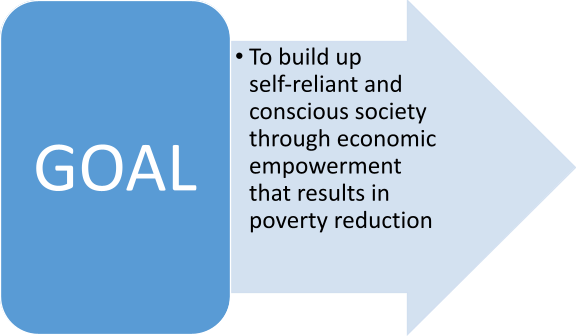
Objectives of the Program
- To reduce poverty in Bangladesh;
- To develop savings tendency among the poor women and adolescents and build up equitable savings among them to reduce livelihood risks and vulnerability originated from lean season of income, various disasters, diseases and longtime inactiveness due to diseases, accidents etc.;
- To create self-employment and scope of wage employment through formation and enhancement of individual business competency of entrepreneurs;
- To provide financial services to the poor women and adolescents in order to facilitate their involvement in economic activities to foster their contribution to their household income;
- To increase the access of poor women and adolescents into the institutional credit and stop pauperization of poor due to loans they receive from the informal sources at a very high interest rate;
- To reduce the dependency of women on men and improve their dignity through raising their voices within the family and society by transforming them into income population;
- To utilize the local resources at the optimum level.
Strategies & Approaches
- Special focus on women’s empowerment;
- Priority on the poor and potential entrepreneurs;
- Participatory Management Approach;
- Conventional and Green Microfinance;
- Value Chain Development;
- Financial Inclusion with services;
- Risk Management
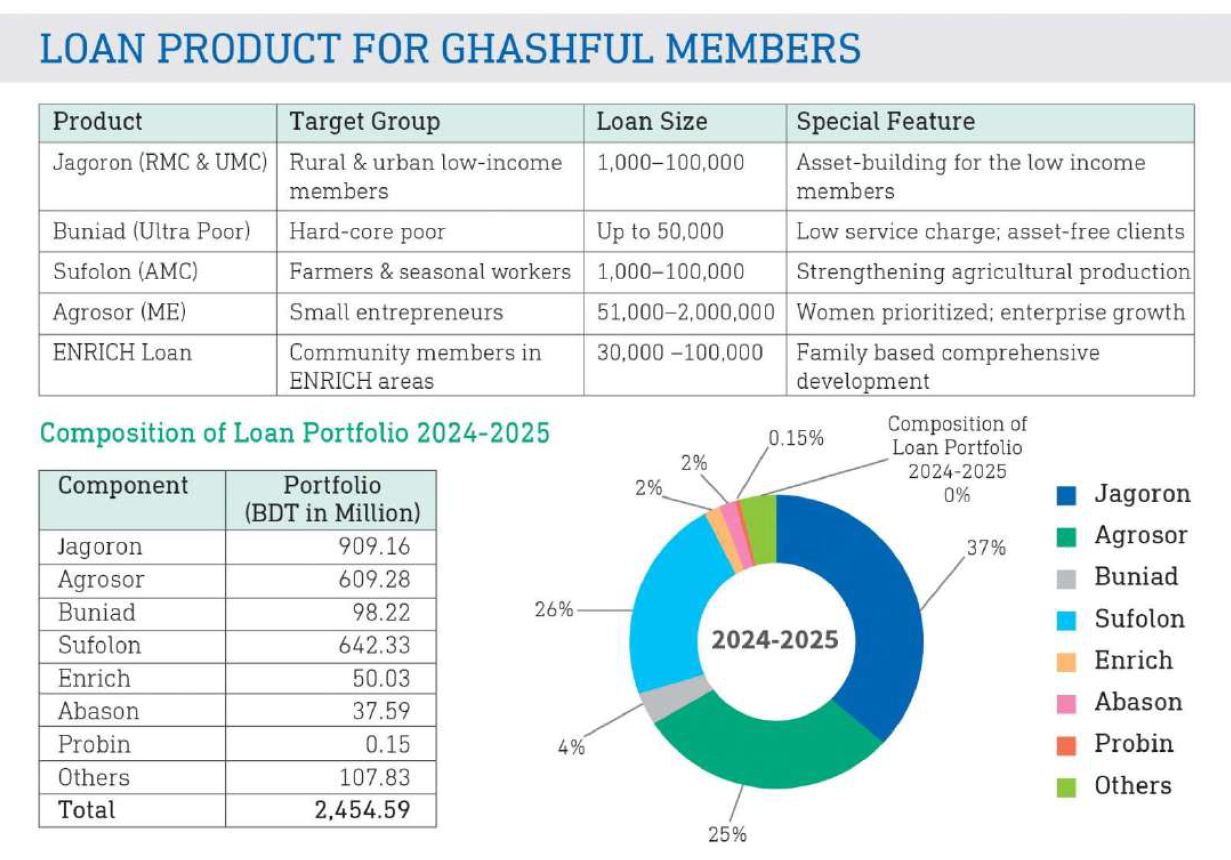
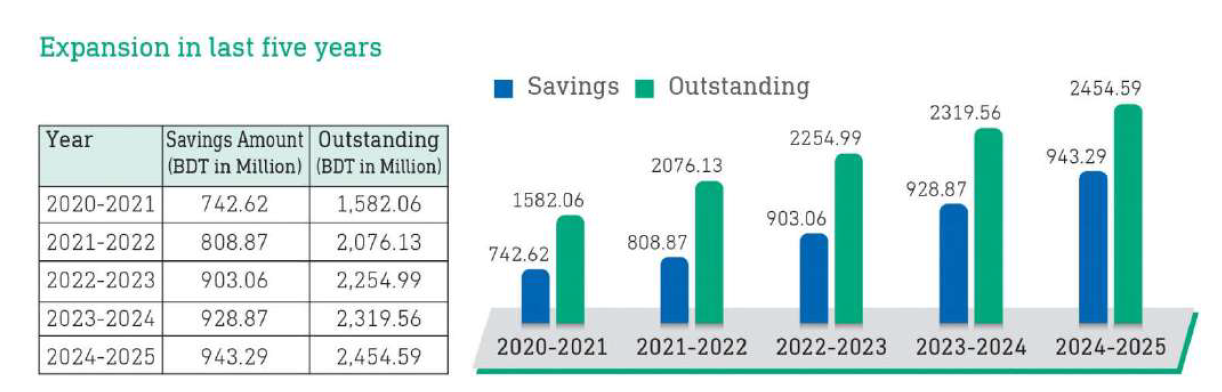
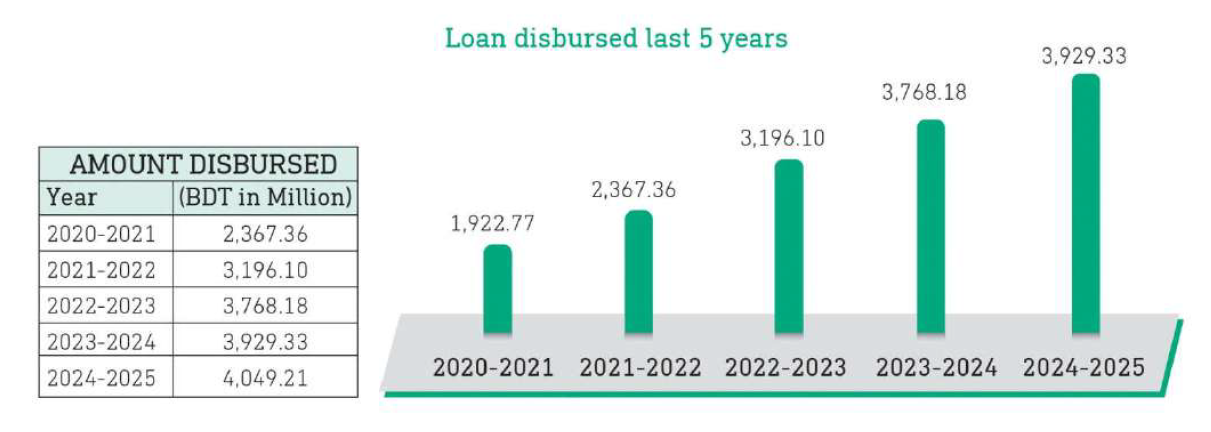
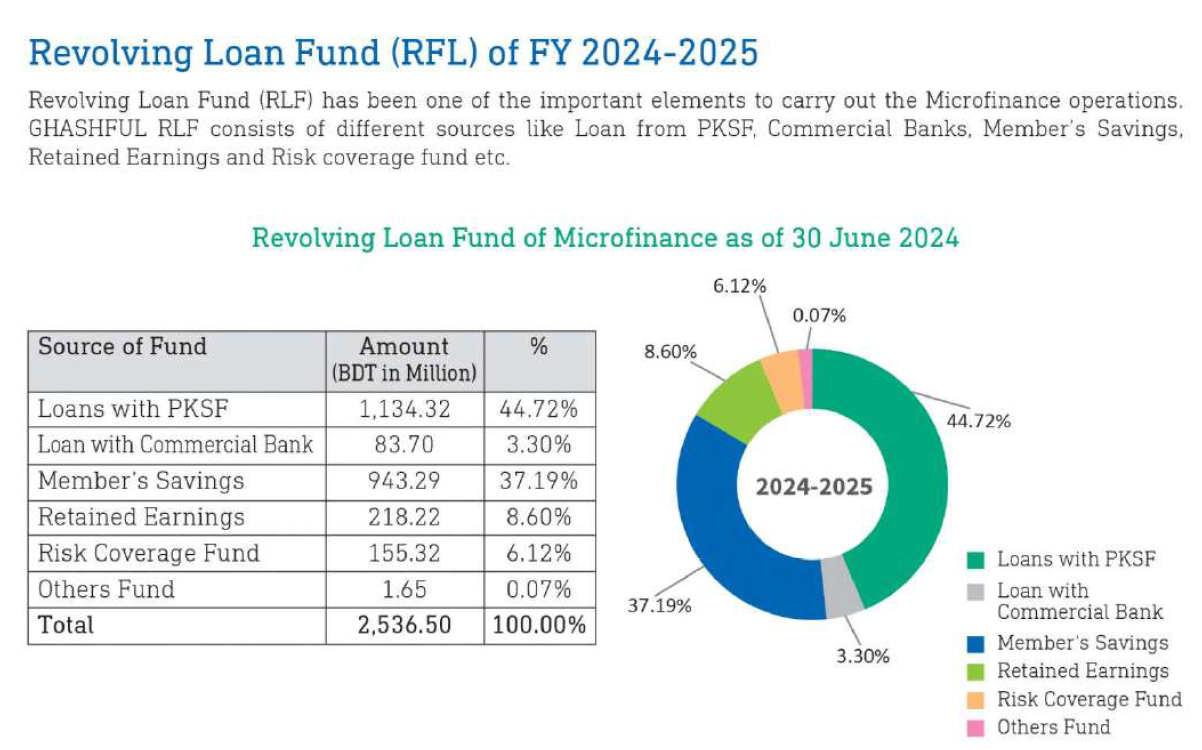
Composition of Risk Coverage Fund
It’s a fact that entrepreneurship is engaged with risks. To mitigate the risks, though small but quite challenging for the poor entrepreneurs, the Microfinance program of GHASHFUL has introduced the benefit package named Risk Coverage Fund for the microcredit clients in 2004. The program was initiated as Micro Life Insurance as one of the vital supports for crisis management and the economic development of the vulnerable entrepreneurs.
The clients have to pay 1% of borrowed amount as premium to avail this facility while the clients of ultra-poor program get the facilities without any premium amount. As per the benefit of this facility, the outstanding loan amount of the respected member is paid to the nominees by GHASHFUL in case of the death/conflagration/damaged by natural disasters of the insured members.