

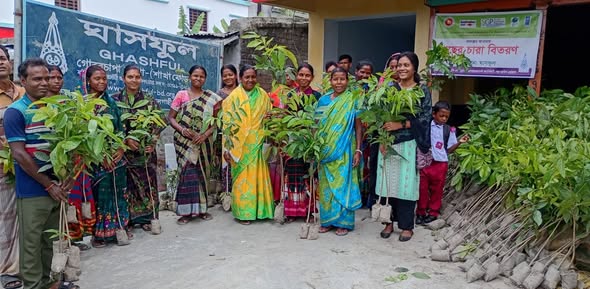
Ghashful has undertaken a unique initiative to strengthen climate resilience among marginalized indigenous communities in Badalgachhi Upazila. Under the Ghashful CARE Project, 1,118 fruit and timber saplings were distributed on 12 May across 17 indigenous villages in Badalgachhi Sadar and Mathurapur unions, with support from local administration and active community participation.
The initiative aims to create green buffers in indigenous settlements while protecting livelihoods from the adverse impacts of climate change. Speaking at the event, the Upazila administration highlighted that such efforts complement national afforestation programs and strengthen local environmental protection movements.
Ghashful officials, including Assistant Director (MF) Saeedur Rahman Khan and Assistant Director (SDP) K.M.G. Rabbani Bosunia, emphasized that the success of this initiative lies not only in sapling distribution but also in long-term care, conservation, and community ownership.
The project is being implemented with support from the United Nations Development Programme and the Global Environment Facility Small Grants Programme, benefiting around 400 households through climate-adaptive and environmentally sustainable practices.
Of the total saplings distributed, 820 were mahogany, 118 amla, 95 arjun, and 85 neem—carefully selected based on local soil and environmental conditions to ensure ecological balance and future economic benefits for the communities.
Experts note that in the drought-prone northern region, where rising temperatures and soil degradation are increasing risks, tree plantation plays a vital role in carbon absorption, soil conservation, biodiversity protection, and climate adaptation. Species like neem, arjun, and amla also contribute to health, nutrition, and traditional medicine.
Project officials stated that beyond plantation, future activities will include climate-resilient agriculture, water conservation, alternative livelihoods, and community-based environmental management.
Local community members expressed hope that these trees will not only restore ecological balance but also become a source of long-term food security and economic stability.